

Boarding Up for Different Property Types in Woking (GU21–GU24)
If you’re responsible for a property in Woking or the surrounding GU21–GU24 districts, you need a boarding-up service that understands how homes, shops, offices and void properties each present different risks. We’ve been securing properties locally for over 10 years, with fully insured, DBS-checked technicians who work 24/7 to make safe, prevent further damage and help you document everything for insurers. Whether it’s a smashed window, a forced door or a roof opening after a storm, we size, cut and fit boards to suit the opening and the property type—using exterior-grade plywood or OSB with anti-tamper fixings—so you can secure the property with confidence.
Not sure which option fits your situation? Call us and we’ll talk you through the best approach for your building and budget. For urgent help, see our emergency boarding up page or contact us on 01483 694 663.
The Property Types We Secure in Woking
We work across residential, commercial and vacant properties throughout Woking and GU21–GU24. Each category has different priorities, access considerations and insurer expectations, so our methods vary accordingly.
Residential Properties (Houses, Flats, Maisonettes)
When a window is smashed or a door is forced at home, the priority is to make safe, keep weather out and restore basic security quickly.
What we consider:
- Frame condition: sash, uPVC, aluminium or timber—fixings and packers chosen to avoid unnecessary damage
- Children and pets: sheet edges checked, protrusions avoided, internal hazards minimised
- Ventilation: after floods or fire, we can allow controlled airflow if advised by insurers or fire service
- Privacy: interior-facing boards for overlooked elevations where appropriate
Typical methods:
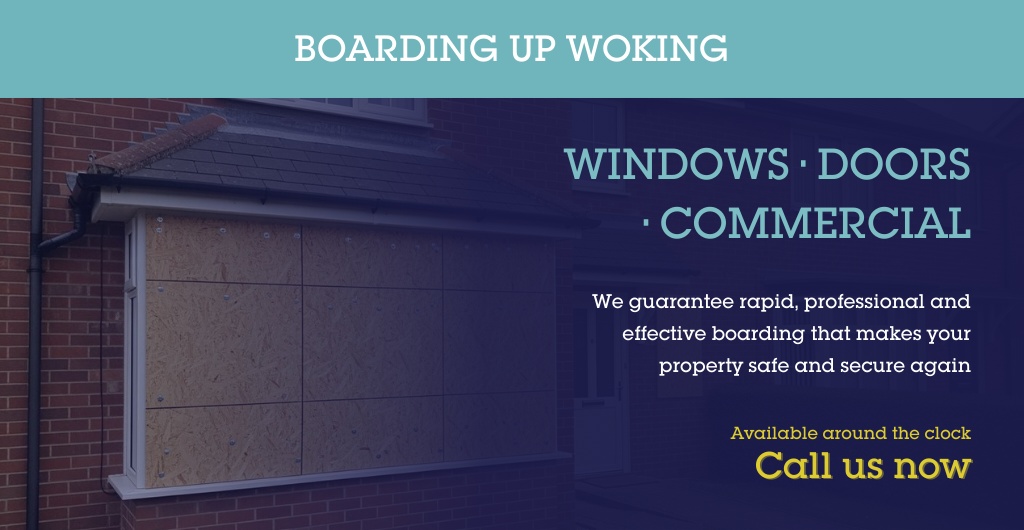
- 18mm exterior-grade plywood for ground-floor windows and doors; 12mm OSB for smaller, first-floor openings
- Anti-tamper fixings that can’t be removed from outside—important if you’ll be away overnight
- Temporary steel door options if the door set is beyond simple boarding
Helpful links:
- Learn what’s involved in window boarding in Woking
- If you’ve had a break-in, see burglary repairs and securing
- More on our approach for residential properties
Commercial Properties (Shops, Offices, Restaurants)
Commercial sites often need larger spans, RAMS where requested, and out-of-hours attendance to minimise downtime.
What we consider:
- Shopfront glazing: wide panels may require multiple joined boards with brace battens to prevent flex
- Public safety: pedestrian management, signage and a clean work area
- Trading continuity: creating a safe, weatherproof frontage so you can re-open quickly
- Documentation: itemised invoices, time-stamped photos and work statements for insurers and management
Typical methods:
- Oversized boards with internal bracing to stop bowing on big shopfronts
- Hidden, anti-tamper fixings where practical to maintain a neat frontage
- Temporary steel doors for forced rear service entrances or roller shutter failures
Helpful links:
- See our shopfront boarding service
- If vandalism is the issue, read post‑vandalism repair and security
- Explore our commercial property solutions
Vacant and Void Properties (Between Tenancies or Long-Term Empty)
Empty buildings attract unwanted attention. You may need something more durable than short-term boards.
What we consider:
- Medium- to long-term security: anti-tamper fixings, non-destructive options where landlord prefers
- Repeated access: options that allow authorised entry without removing panels
- Weathering and ventilation: balancing security with moisture control to limit further damage
- Neighbour impact: tidy presentation and reduced noise during fitting
Typical methods:
- Exterior-grade plywood with anti-tamper anchors for windows
- Temporary steel doors for reliable access and strong resistance to forced entry
- For longer voids, we can discuss steel security options to reduce repeated call-outs
Helpful links:
- Learn about door boarding and temporary steel door options
- If the property suffered fire damage, see post‑fire securing
- More detail on vacant property boarding
Our Approach: Secure, Documented, Transparent
When you call, we’ll ask the right questions to understand the property type, opening size, frame condition and access. On site, we:
- Make safe the area and assess the frame and surrounding structure.
- Measure and cut boards precisely; choose material (usually 18mm ply or 12mm OSB) to suit the opening and risk.
- Fix boards using anti-tamper screws/bolts, packers and spreader plates if needed to protect frames.
- Check for weatherproofing needs and add sealing where appropriate.
- Provide time-stamped photos and an itemised invoice with notes on materials and fixings for insurance.
If a frame is too damaged for non-destructive methods, we’ll explain the options before we proceed. We do not claim to be loss adjusters, but we provide the documentation insurers typically require. For general queries, our FAQs and insurance claims guidance may help.
Materials and Methods by Property Type
- Residential
- 18mm exterior-grade plywood at ground level for strength and security
- 12mm OSB on smaller, higher openings to reduce weight while maintaining coverage
- Anti-tamper fixings to prevent removal from outside—critical if the property is unattended
- Commercial
- Large-span boarding with bracing battens to reduce flex across shopfronts
- Neat, low-profile fixings and cut lines to maintain a professional appearance
- Temporary steel doors for loading bays or service entrances
- Vacant/Void
- Anti-tamper anchors and fixings designed for medium-term retention
- Temporary steel doors to allow managed access without re-boarding
- Options discussed for longer-term security if repeat attempts occur
You can read more about the core techniques on what boarding up is, and the specific services here:
When Property Type Matters Most
Certain events change the priorities depending on the building:
- Burglary at a terraced home: secure rear door first, then any smashed glazing; consider a temporary steel door overnight. See burglary repairs.
- Vandalised shopfront on a high street: prioritise public safety and quick trading resumption. See vandalism repair.
- Storm-damaged roof light on a warehouse: overhead access, weatherproofing and temporary covers. See storm damage and roof boarding.
- Fire in a flat block: liaise with fire service, avoid disturbing investigations, secure without impeding escape routes. See fire damage.
- Flooded ground-floor unit: swollen frames may not take standard fixings—non-destructive methods and ventilation gaps may be necessary. See flood damage.
- Accidental impact at an office: check for structural issues before boarding; coordinate with facilities teams. See accident damage.
If you’re unsure, call us—we’ll explain options tailored to your property and situation.
What You Get As Standard
- Rapid, prioritised attendance across GU21–GU24 (we’ll give a realistic ETA on the phone)
- DBS-checked, fully insured technicians
- Appropriate materials: 18mm exterior-grade plywood or 12mm OSB, anti-tamper fixings
- Clean, tidy work with emphasis on safety and weatherproofing
- Time-stamped photos, itemised invoices and a brief work statement for insurers
- Clear explanation of options and limitations before we proceed
For a sense of cost factors, see our honest overview on pricing. We don’t publish flat rates because sites and property types vary.
Coverage Across Woking and GU21–GU24
We cover residential, commercial and vacant properties across Woking and the surrounding GU21, GU22, GU23 and GU24 districts. That includes neighbourhoods such as Horsell, Knaphill, Goldsworth Park, Old Woking, Westfield, Pyrford and more. You can view our areas we cover or go straight to local pages like:
- Boarding up in Goldsworth Park (GU21)
- Boarding up in Old Woking (GU22)
- Boarding up in Ripley (GU23)
- Boarding up in Bisley (GU24)
FAQs: Property-Type Considerations in Woking
Do you board up flats differently from houses?
Yes. Access, fire regulations and communal areas in blocks mean we consider escape routes and shared hallways. Fixings and board placement are chosen to avoid blocking communal egress while still securing your unit.
We’re a shop in GU21—can you attend out of hours to make the shopfront safe?
Yes. We provide 24/7 boarding up in Woking. We’ll secure the frontage, manage pedestrian safety, and provide the documentation your insurer and landlord typically require.
I manage a vacant property in GU22—can you fit a temporary steel door for repeated access?
Absolutely. For void properties we often recommend a temporary steel door so contractors and agents can access without re-boarding each time. See our approach to door boarding and temporary doors and vacant property solutions.
Can you help if the door frame is too damaged to take screws?
Yes, but we’ll assess on site. If the frame can’t support non-destructive boarding, we’ll explain alternatives (through-frame bracing, temporary steel door, or securing to masonry where safe). We’ll talk you through the trade-offs before proceeding.
Do you provide RAMS for commercial sites in GU23 and GU24?
We can provide risk assessments and method statements on request for commercial and managed sites. Let us know when you call so we can prepare appropriately.
How do you handle roof and skylight openings on commercial buildings?
We carry materials for roof boarding and emergency weatherproofing. Access equipment may be required; we’ll discuss feasibility and safety before attendance, then prioritise making the area safe and watertight.
Will insurers in Woking accept your documentation?
We’re not adjusters, but we issue time-stamped photos, itemised invoices and work statements that insurers typically request. For claims tips, see our insurance guidance.
Can you advise what to do while I wait?
If it’s safe, take photos, keep your police reference number if it’s a break-in, and avoid touching broken glass. For immediate steps and an ETA, visit emergency boarding up or call us.
Next Steps
- For urgent help now: Call 01483 694 663
- For planned work or questions: Email us or see contact details
Ready to secure your property? We cover all property types across Woking and GU21–GU24—residential, commercial and vacant—any time of day or night.